

MLR review brings medical, legal, and regulatory judgment to bear on every claim, balance statement, and disclosure in a promotional email before it can deploy. That rigor is non-negotiable, and the quality of what enters the process determines how efficiently it proceeds.
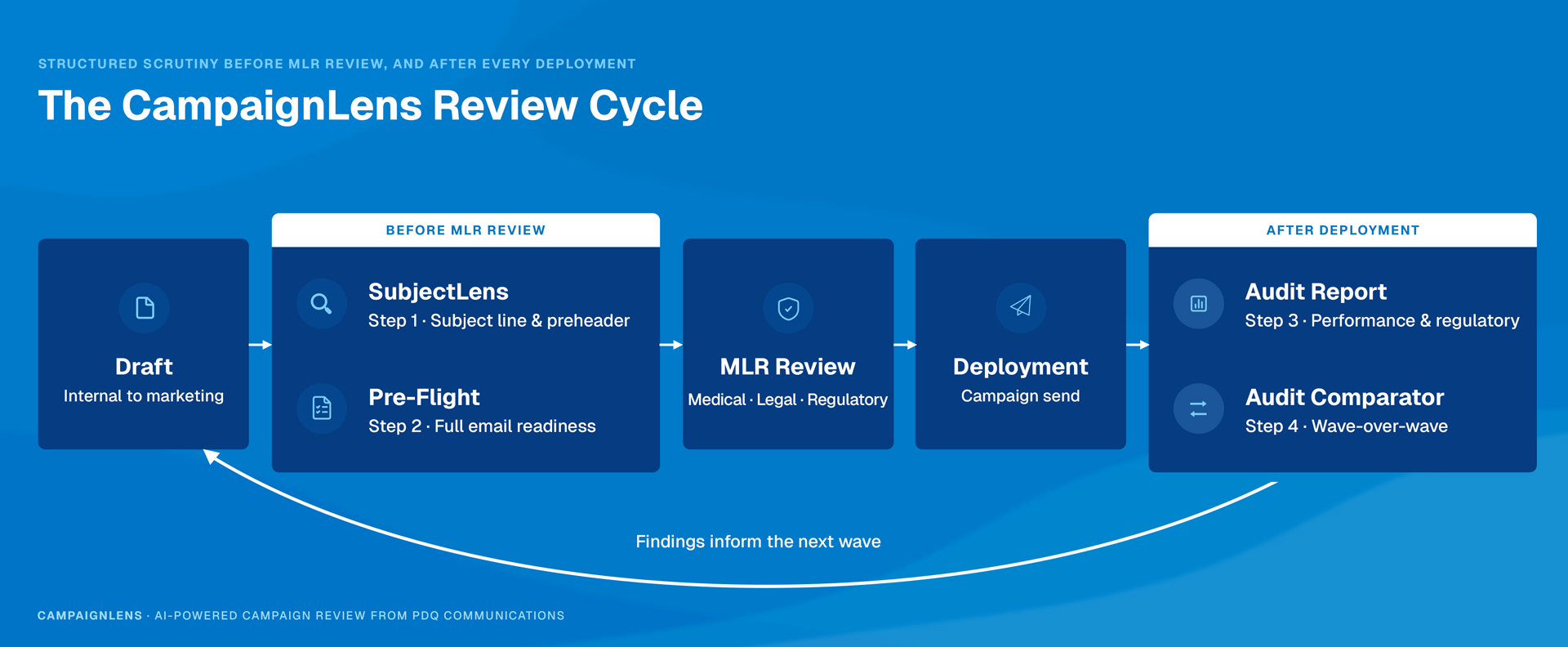
CampaignLens is PDQ's four-step, AI-powered review system for HCP and pharma email. It applies structured scrutiny at two points relative to MLR review: before submission, while a draft is still internal to the marketing team, and after deployment, when findings from a completed campaign inform the wave that enters MLR review next.
Where CampaignLens Fits Around MLR Review
Two touchpoints matter in promotional review.
Ahead of submission: SubjectLens (Step 1) surfaces language in the subject line and preheader that may warrant closer regulatory attention, while Pre-Flight (Step 2) audits the technical condition of the full email, both while the draft remains internal to the marketing team.
After deployment: Audit Report (Step 3) grades the campaign against a five-pillar framework and accounts for regulatory integrity as part of that evaluation. Its rewrite priorities become development input for the next wave.
The two touchpoints serve different functions: one strengthens a draft before MLR review, and the other converts a completed campaign into guidance for the next one.
Review Across the Full Campaign Lifecycle
CampaignLens includes four steps in total. The two touchpoints above draw on three. A fourth step, Audit Comparator, extends the post-deployment analysis across multiple waves. Together, they address the full campaign lifecycle:
- SubjectLens scores the subject line and preheader as a pair, since that is how they function in the inbox.
- Pre-Flight audits the full email for deployment readiness before it ships.
- Audit Report evaluates a sent campaign against a five-pillar framework across 10 graded elements.
- Audit Comparator explains why performance shifted between two waves of the same campaign.
The first two steps precede submission. The second two follow deployment.
Before MLR Review: Scrutiny While the Draft Is Internal
SubjectLens: Subject Line and Preheader Scrutiny
SubjectLens evaluates the subject line and preheader as a pair across five dimensions: spam and deliverability, open-rate potential, HCP audience fit, clinical clarity, and pair synergy.
For teams preparing a draft for MLR, one of its most important functions is identifying language that may warrant closer review. Potential efficacy claims and implied clinical outcomes are surfaced, preserving the judgment of the medical, legal, and regulatory reviewers responsible for the final determination.
SubjectLens also gives teams actionable guidance to improve the pair before submission, including:
SubjectLens returns:
- A verdict on what the pair accomplishes and where it limits opens
- The single highest-impact improvement
- Technical flags: character count, ALL CAPS, punctuation, truncation, fallback risk
- Apple Mail exposure warnings for iOS 18+, where AI summaries may replace the preheader
- An automatic ceiling when the preheader repeats the subject line, weakening the pair.
- Three scored alternative subject lines with rationale
- Three alternative preheaders paired with the strongest subject line
Pre-Flight: Full Deployment Readiness
Pre-Flight addresses a different category of risk. It audits the email across five categories: message effectiveness, mechanics, inbox placement, render quality, and failure forecast. Mechanics covers CTA links that resolve, merge fields that render with fallbacks, and buttons that are real rather than images.
Every audit returns one of four deployment decisions: READY, FIX & SEND, HOLD, or REBUILD. Supporting that decision:
- Critical gaps, including broken CTA links, missing unsubscribe functionality, oversized files, and render failures
- An element-by-element breakdown across nine scored areas
- A prioritized fix list of up to seven items, each tagged BLOCKER, HIGH, MEDIUM, or LOW
- Quick wins that can be completed in under 15 minutes
- A structural diagnosis naming the predicted dominant failure mode
- A post-click expectations brief for the landing destination
Critical gaps block deployment regardless of an otherwise strong score, so for example, a single broken link cannot pass on the strength of good copy. Several gaps carry regulatory weight of their own. A missing unsubscribe mechanism, for instance, is a legal requirement rather than a design preference.
After Deployment: Carrying Findings Into the Next Wave
HCP email campaigns are rarely single events. Echo deployments follow up with non-openers, and multi-wave campaigns build on what earlier sends established, which makes post-deployment evaluation a forward-looking exercise rather than a retrospective one.
Audit Report
Audit Report evaluates a sent campaign against the five-pillar framework of Earn, Hook, Deliver, Move, and Convert across 10 graded elements. A campaign snapshot anchors the evaluation to the audience and awareness stage, while regulatory integrity, including ISI, fair balance, and prescribing information, along with promotional language risk, are accounted for throughout.
How Regulatory Integrity Factors Into Scoring
The regulatory function here works differently than it does in SubjectLens. Rather than producing a discrete compliance flag, regulatory integrity informs how elements are graded and how rewrite priorities are ordered. It shapes the evaluation instead of standing apart from it.
Audit Report returns the top five rewrite priorities ordered by impact, alongside quick wins and a structural diagnosis. A promotional language concern, for example, can surface as a rewrite priority rather than as a separate compliance note. Audit Comparator extends that analysis across waves, returning up to six recommendations tied to the specific metrics they are designed to move.
For a team planning the next wave, that guidance informs development before a new draft takes shape.
Prioritization Makes Revision Actionable
Surfacing an issue matters only if a team knows which to address first. Because CampaignLens output arrives categorized and ordered by impact, teams gain several practical advantages:
- Concerns surface while an email is still in development rather than after submission.
- Drafts reach MLR review in stronger condition, with preventable issues already resolved.
- Revisions stay focused, since prioritized fixes separate blockers from lower-priority improvements.
- Pre-send quality control gains consistency, replacing scattered QA checklists with one consolidated audit.
Why a Purpose-Built System Outperforms Generic AI
The advantage of CampaignLens is not simply AI-powered review. It is a purpose-built framework that applies the same defined checks, risk logic, and standards consistently across every campaign.
In theory, generic AI could support individual reviews, but that approach is essentially impossible to sustain or scale reliably. Organizations must define what gets evaluated, assemble and maintain the governing source material, develop and test prompts, establish consistent risk thresholds, standardize outputs, and continuously update the system as requirements evolve.
CampaignLens operationalizes that work specifically for HCP and pharma email. Its dimensions, categories, and output structures are already built into a repeatable system, enabling consistent evaluation across campaigns without requiring teams to recreate the methodology each time.
Modernizing the MLR Review Process
Building CampaignLens into the MLR review process creates a smarter, more consistent approach to campaign evaluation. It helps teams identify risk earlier, apply the same standards across every review, reduce avoidable back-and-forth, and surface issues before they slow approval. The result is a more efficient review process that supports stronger decision-making, greater consistency, and faster movement from draft to deployment.
Frequently Asked Questions
Pair the Technology With HCP Marketing Expertise
An AI-powered review system is one part of a stronger HCP email process. PDQ Communications brings the expertise that surrounds it, from audience segmentation and list sourcing to campaign strategy and execution, all built specifically for HCP and pharma email marketing. Together, these capabilities bring greater rigor to campaign development and support a broader HCP marketing strategy that accounts for audience, message, deliverability, compliance, and performance.
Ready to strengthen your HCP email process around MLR review? Contact PDQ Communications to learn more about CampaignLens and how it can help your team build a more rigorous, repeatable path to review-ready campaigns.