

Most HCP marketing teams have no shortage of data to measure email engagement. Open rates, click-to-open rates, unsubscribes, and conversions provide a clear picture of campaign results. What those metrics don't provide is a clear explanation for why a campaign succeeded—or failed.
That's where many healthcare marketing teams get stuck. Without a structured approach to evaluate performance, it's easy to speculate whether the issue was the subject line, creative, timing, deliverability, or audience targeting. Improving email engagement requires more than reviewing metrics after the fact. It requires understanding the factors that influenced those results.
CampaignLens, PDQ Communications' AI-powered campaign intelligence platform, was built specifically for HCP and pharma email marketing to provide evidence-based diagnosis throughout the campaign lifecycle, from pre-send optimization to post-campaign analysis and cross-wave performance comparisons.
Metrics Tell You What Happened, Not Why
Diagnosing campaign performance has become more complex than simply reviewing a dashboard of metrics. Apple's Mail Privacy Protection (MPP), for example, now obscures a significant amount of tracked email opens, making open rates less reliable as a standalone performance metric.
Yet email remains one of the most important channels for reaching healthcare professionals. To wit, HealthLink Dimensions’ 2025 Physician Communications Report, based on responses from 398 licensed U.S. physicians, found that email remains the dominant channel for reaching physicians.
In short, the challenge isn't collecting campaign data; it's connecting those metrics to the creative, technical, and operational decisions that shaped the outcome.
Questions like these often remain unanswered:
- Did the subject line discourage opens?
- Did the email fail to deliver on its promise?
- Were there technical issues affecting deliverability?
- Was the call to action unclear?
- Did performance shift because of audience, timing, or list fatigue?
Without structured analysis, campaign reviews often become opinion-based instead of evidence-based.
A Better Way to Diagnose Email Engagement
CampaignLens takes a fundamentally different approach to campaign analysis. Rather than evaluating individual metrics in isolation, it functions as a four-step AI-powered review system purpose-built for HCP and pharmaceutical email marketing.
Together, the four components assess the factors that influence email engagement across the entire campaign lifecycle: from pre-send optimization and deployment readiness to post-campaign analysis and cross-wave performance diagnosis.
By evaluating creative, technical execution, deliverability, and campaign performance as an integrated system, CampaignLens helps marketers move beyond reporting metrics to understanding what influenced them, and where improvements are most likely to have an impact.
Step 1: Optimize Before Deployment
Campaign performance often begins in the inbox. SubjectLens evaluates the two elements that most influence whether an HCP opens an email, the subject line and preheader (preview text), because they work together, not independently.
Each subject line and preheader is scored across five dimensions:
- Spam and deliverability
- Open rate potential
- HCP audience fit
- Clinical clarity
- Subject line/preheader synergy
SubjectLens also identifies technical issues, recommends the single highest-impact improvement, generates alternative subject lines and preheaders, flags Apple Mail considerations, and surfaces potential compliance signals for MLR review.
Step 2: Validate Deployment Readiness
Even the strongest creative can underperform if technical issues prevent a successful deployment. Pre-Flight evaluates the complete email before it is sent, assessing:
- Message effectiveness
- Email mechanics (links, merge fields, buttons)
- Inbox placement
- Render quality
- Predicted failure modes
Based on its analysis, Pre-Flight returns one of four deployment recommendations:
- READY
- FIX & SEND
- HOLD
- REBUILD
It also provides prioritized fixes, identifies critical blockers, highlights quick wins, and delivers a structural diagnosis to help resolve issues before deployment.
Step 3: Diagnose Post-Campaign Performance
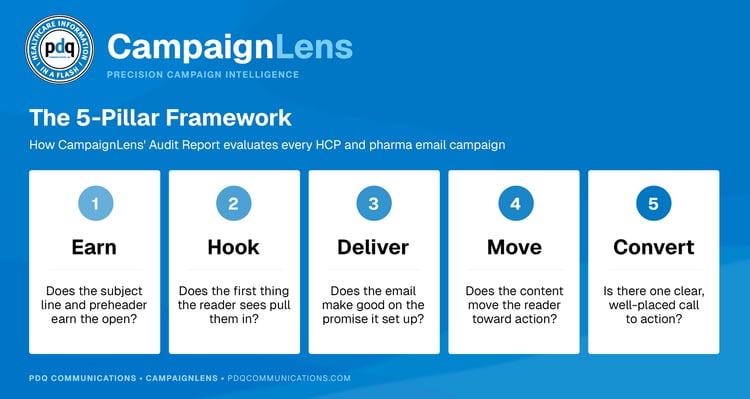
Once a campaign has been deployed, CampaignLens generates an AI-powered Audit Report that evaluates performance against a five-pillar framework: Earn, Hook, Deliver, Move, and Convert.
The report combines performance scoring, benchmark-based metric interpretation, structural diagnosis, rewrite priorities, quick wins, and post-click recommendations to identify the specific factors contributing to campaign performance.
Rather than simply indicating that a campaign underperformed, it explains why.
Step 4: Compare Campaign Performance Over Time
Performance often changes from one campaign wave to the next, but the reasons aren't always obvious.
Audit Comparator analyzes two waves of the same campaign by evaluating score shifts, metric movements, send timing, list dynamics, and external factors together.
It then produces an evidence-based diagnosis, ranking likely causes by confidence level while recommending the changes most likely to improve future campaign performance.
Improving Email Engagement Starts With Better Diagnosis
Improving HCP email engagement requires more than incremental changes to subject lines, copy, or creative. It requires understanding how messaging, technical execution, audience targeting, and campaign structure collectively influence performance.
CampaignLens provides a structured, evidence-based framework for evaluating each stage of the campaign lifecycle, helping marketing teams determine:
- What contributed to campaign success
- Where opportunities for improvement exist
- Why performance changed
- Which optimizations are most likely to improve future results
Rather than relying on assumptions or isolated metrics, healthcare marketers receive prioritized, actionable recommendations grounded in a comprehensive analysis of campaign performance.
Frequently Asked Questions
Improve Your HCP Email Engagement With CampaignLens
Effective optimization requires more than campaign reporting. It requires a repeatable framework for evaluating performance and identifying meaningful opportunities for improvement.
Purpose-built for HCP and pharmaceutical email marketing, CampaignLens helps teams assess campaigns more consistently, prioritize optimization efforts, and continuously improve email performance over time.
The greatest value, however, comes from pairing those insights with experienced guidance in healthcare marketing. As your strategic HCP marketing partner, PDQ Communications helps healthcare organizations move beyond campaign reporting to continuous optimization. By combining CampaignLens' AI-powered analysis with decades of healthcare marketing expertise, PDQ helps clients make more informed decisions, improve HCP email engagement, and build stronger-performing campaigns over time.